

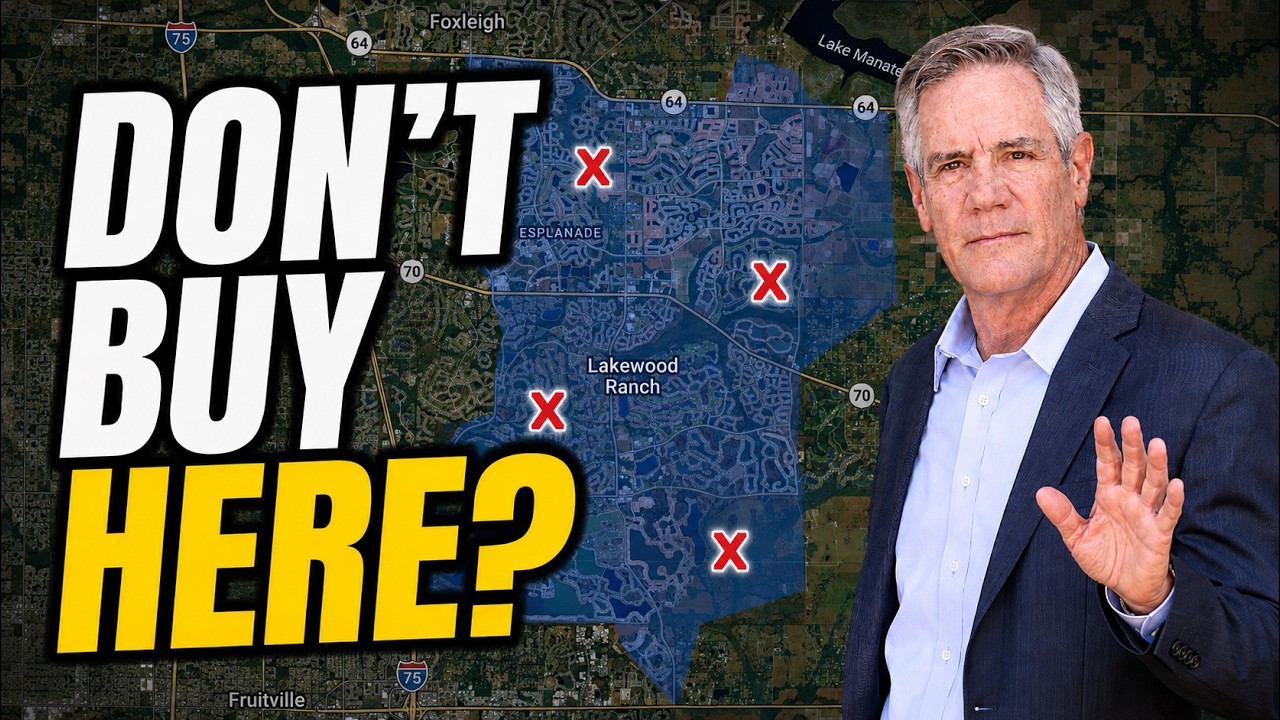
Every week somebody asks me the same question: which Lakewood Ranch locations to avoid, and which ones are actually worth a second look. A client called me a little while back almost in a panic — she’d fallen in love with a house, gotten to the closing table, and found out the CDD was running $250 a month more than she’d budgeted for. She wasn’t upset about the neighborhood. She just hadn’t known to ask the right question before she made an offer.
Here’s what I tell every buyer who asks me this: it’s not that any part of Lakewood Ranch is bad. It’s that certain areas are wrong for certain buyers, and exactly right for someone else. I walk you through four real situations below — the same ones I cover in the video — so you know which side of each one you’re on before you sign anything.
The Honest List of Lakewood Ranch Locations to Avoid
None of these four situations mean you should cross a neighborhood off your list outright. They’re the four Lakewood Ranch locations to avoid only if you skip the right question — ask it first, and any one of them might be exactly right for you. Here’s what I walk clients through, one situation at a time.
Retention Pond Lots: Water Views vs. Flood Risk
Plenty of homes here sit right up against a retention pond, and for a lot of buyers that’s the whole appeal — the water view, the resale value down the road. But if you’re the type who gets nervous about flood insurance, storm surge, or the occasional alligator, a pond lot is exactly the kind of thing you want to slow down on and actually investigate before you write an offer.
Here’s something most people don’t know about our area: the groundwater isn’t very deep. I joke that if you take a shovel and dig down six feet, you might hit water. So think about what 16 inches of rain in 24 hours can do. Most of the time it’s not even the ponds that back up — it’s the rainwater sitting on the roads that can’t drain as fast as it’s coming down. During one of the hurricanes we had a few years back, the streets in a lot of these neighborhoods looked rough, but no flooding was actually recorded in the homes. The streets held the water so the houses didn’t have to.
If your home sits in an X flood zone, flood insurance usually runs under $1,000 a year. And here’s a detail people miss: flood insurance covers any external source of water. If a neighborhood sprinkler line breaks, or somebody hits a fire hydrant down the street and it floods your home, that’s an external source — that’s a flood claim, not a homeowner’s claim. When we moved here from Atlanta, flood zone wasn’t even a question I knew to ask. Now it’s one of the first things I walk every client through, and for the record, the average elevation in Lakewood Ranch is 47 feet — higher than most people assume for Florida.
Homes Near the Road: Noise vs. Convenience
Some communities back right up to a main road, and you can hear the traffic the moment you step outside. For a lot of my clients, especially retirees looking for quiet, that’s a dealbreaker. For someone who wants the shortest commute to I-75 and doesn’t mind a little road noise, that same location is a winner.
After doing this for years, I’ve noticed it usually comes down to where a buyer is moving from. Someone coming here from Manhattan or Chicago barely registers the traffic. Someone coming from Montana or Iowa hears it right away. Homes that back up to a road are usually a little harder to sell, but in the end, the right price finds the right buyer every time.
New Construction: Short-Term Hassle for Long-Term Upside
The third situation is a community still being built out — dirt lots, construction trucks rolling through, the whole thing. If you move in now, you’re going to live with that for a while. Some buyers love it because it means getting in at a lower price point before the community is finished. Others can’t stand living next to a construction zone for a year, two, three, or four. Neither answer is wrong — you just need to know which one you are before you sign.
Here’s the trade-off in plain terms: a brand-new community’s home value generally rises as it fills in and finishes out, but that appreciation comes with a price tag while you wait — construction noise, extra traffic, dust, and the occasional nail in your driveway or your tire. You’re trading short-term hassle for long-term upside. Just go in knowing that’s the deal.
CDD and HOA Fees: The Lakewood Ranch Cost Buyers Forget to Ask About
The last item on my list of Lakewood Ranch locations to avoid isn’t really about location at all — it’s cost. Plenty of communities here carry both a CDD and an HOA on top of your mortgage, and depending on the community, that adds real money to your monthly payment. I’ve had clients fall in love with a house, get to the closing table, and realize the CDD alone was $200 to $300 a month more than they had budgeted for. That’s not a reason to avoid the community — it’s a reason to ask the question before you make an offer, not after.
So what is a Community Development District, really? I equate it to a city tax. Lakewood Ranch is a town, not a city, so the infrastructure — roads, amenities, all of it — has to get funded somehow, and that’s what the CDD pays for. If you’re moving here from Boston, Chicago, or New York, you’re used to paying a city tax instead; it’s basically the same concept. It just shows up on your property tax bill at the end of the year as a non-ad valorem assessment.
Here’s a rule of thumb I give every client: budget somewhere around 1.3 to 1.5% of your purchase price for your total tax bill on a new purchase. And one important warning — don’t look at the current owner’s tax bill and assume yours will be the same. In Florida, your tax bill reassesses based on what you pay for the home, so it can end up higher or lower than what the seller was paying.
So, Which Lakewood Ranch Locations Should You Actually Avoid?
Honestly, none of them outright. The real answer is that you need to know exactly what you’re buying into and whether it fits your situation — the flood zone, the noise, the construction timeline, and the CDD and HOA fees. Ask those four questions before you fall for a house, and you’ll know within minutes whether a neighborhood is one to avoid or one that’s exactly right for you.
If you want me to walk you through your own short list of Lakewood Ranch locations to avoid, and which ones actually fit you, give me a call or send me a text — my number’s on the site. And if you’re curious what’s happening with Lakewood Ranch prices right now, check out my recent post on why this is a seller’s market where prices are still coming down.
— Mark B, Michael Saunders & Company
