

A seller called me the week this law hit the local news, half-convinced I was about to tell him his listing was in trouble. He’d just paid off his house, his property taxes ran about $2,800 a year thanks to homestead and the Save Our Homes cap, and he wanted to know why a new Florida property tax listing law would change anything about how his home gets marketed. Fair question — and if you’re planning to sell in Lakewood Ranch anytime in the next year, you deserve the real answer, not whatever version is floating around your neighborhood Facebook group.
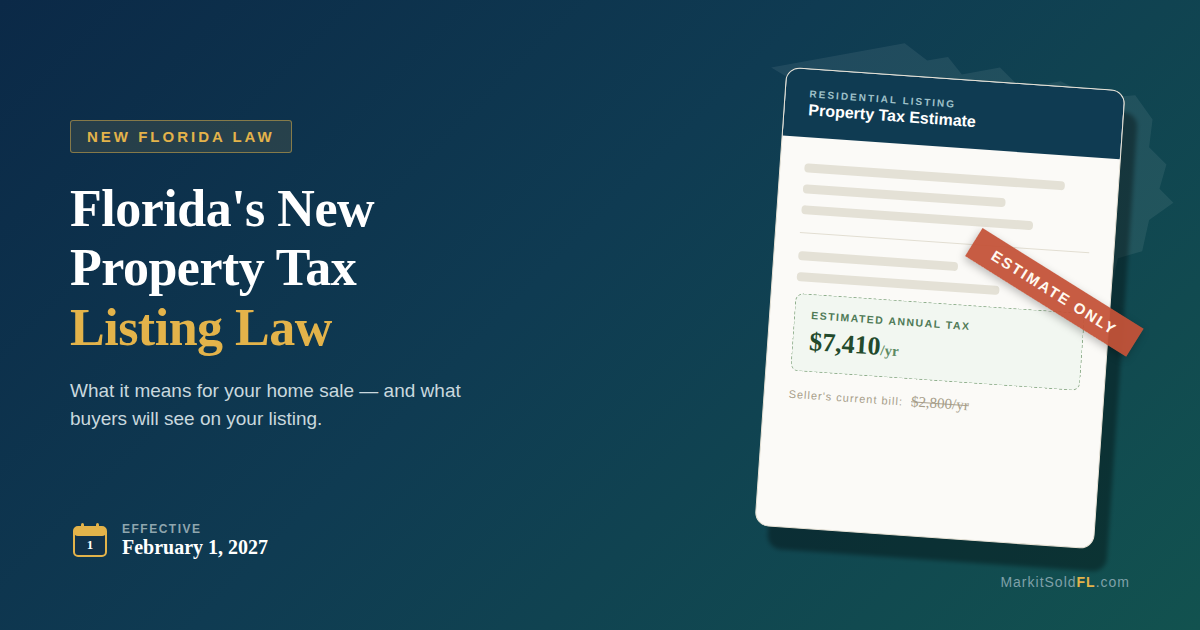
Here’s the short version: starting February 1, 2027, your current property tax bill will be removed from your listing, and buyers will see a standardized estimate instead. It’s not a penalty, and it doesn’t cost you a dime as the seller, but it does change what buyers see the moment they pull up your home online — worth understanding before your sign goes in the yard.
What the Florida Property Tax Listing Law Actually Requires
The rule comes out of House Bill 7031E, a tax bill the Legislature passed and the Governor signed into law on June 29, 2026 (Chapter 2026-239, Laws of Florida). Buried inside a much larger tax package is a section titled “Disclosure of Estimated Ad Valorem Taxes,” and it’s the part that affects every listing agent and every online listing platform in the state.
Starting February 1, 2027, online residential listings must show a standardized estimate of the property’s future ad valorem (property) taxes, calculated from the listing price and the millage and assessment data the Florida Department of Revenue publishes —not whatever the current owner happens to be paying. Platforms that don’t want to build that calculation can skip the estimate entirely and instead point buyers to the county property appraiser’s own tax estimator tool.
Why Lawmakers Went After This
If you’ve sold a home in Florida before, you know the problem this fixes. Longtime owners benefit from the Save Our Homes cap and homestead exemption, which can hold their taxable value, and their bill, well below what the home would be assessed at on the open market. My seller with the $2,800 bill is a perfect example — once his home sells and gets reassessed at market value the following year, the new owner’s bill could run two or three times higher. For years that gap showed up as a nasty surprise about twelve months after closing. That’s the gap the Florida property tax listing law closes: lawmakers heard enough of those complaints, and enough confusion during the home search itself, to stop listings from showing a number that was never going to apply to the buyer anyway.
What Changes on Your Listing as a Seller
Here’s what the Florida property tax listing law means once you list with me in Lakewood Ranch after February 1, 2027. Your current tax amount — the one on your TRIM notice, the one you’ve paid for years — no longer appears on the public-facing listing. Instead, buyers see a projected number based on your asking price, which in almost every case runs noticeably higher than what you’ve been paying.
You don’t have to do anything to make this happen. It’s built into how listings sync to the MLS and the major consumer sites, and keeping your listing compliant is my job, not yours. What I want every seller to understand going in: buyers will see a bigger tax number next to your home’s price than the one on your current bill, and that’s by design, not a listing mistake.
| Before February 1, 2027 | After February 1, 2027 |
|---|---|
| Listing could show the seller’s current, actual property tax amount | Seller’s current tax amount is restricted from the listing |
| Buyers often assumed the seller’s tax bill would carry over | Buyers see a standardized estimate based on listing price and current millage rates |
| Tax “surprises” typically surface after closing, at reassessment | A more realistic tax figure is visible during the home search itself |
| No fallback if a platform skipped an estimate | Platforms without an estimate must link to the county property appraiser’s tax estimator |
What This Means for Your Pricing Conversation
This is the part of the Florida property tax listing law I’d rather walk sellers through before it becomes a surprise: a higher estimated tax figure next to your list price can change how a buyer reads your home’s total monthly cost, even though it has nothing to do with what you’re actually asking for the house. When we talk pricing strategy for your listing, this is now part of that conversation — not because it affects your bottom line, but because it affects how buyers perceive affordability the moment they see the listing. On the buying side, if you’re house hunting, don’t budget off a seller’s current tax bill either — ask your agent, or run the county property appraiser’s own estimator, for what your taxes will actually look like once the home is reassessed under your ownership.
Where to Check Your Own Numbers
You can see this in action before the law even takes effect. The full text and status of HB 7031E is on the Florida Senate’s website, and the Pinellas County Property Appraiser’s office has a clear breakdown of the new methodology. For Lakewood Ranch, Manatee County and Sarasota County both run their own property appraiser tax estimator tools — run your own numbers there rather than guess.
If you read my earlier piece on the Florida property tax changes on this November’s ballot, this law is a separate, unrelated piece of the puzzle — that one is about the homestead exemption amount; this one is about what shows up on a listing.
Let’s Talk Before You List
I am Mark Boehmig, a Lakewood Ranch listing agent with Michael Saunders & Company. I’m not a tax professional, and I always recommend confirming specifics with your accountant or the county property appraiser’s office. If you’re thinking about selling and want to understand exactly how the Florida property tax listing law will show up on your home’s listing, I’m happy to walk through it with you before we ever put a sign in the yard.
📞 Call or text me directly at 941-807-6936, or visit my contact page to get started.
— Mark Boehmig, Michael Saunders & Company
